Pioneering for Change: Global Business Education in the Sci-tech Innovation Era, Fudan SoM hosted 2025 AAPBS Academic Conference
Association of Asia-Pacific Business Schools (AAPBS) Academic Conference was held at School of Management at Fudan University (Fudan SoM) from May 18 to 20, 2025.
Scholars and industry guests gathered to discuss, centered on the theme “Pioneering for Change: Global Business Education in the Sci-tech Innovation Era.” Through keynote addresses and panel discussions, attendees shared insights on research progress, education trends, and the transformative role of technology in management education. They also explored pathways for business schools worldwide to embrace innovation and achieve new development.

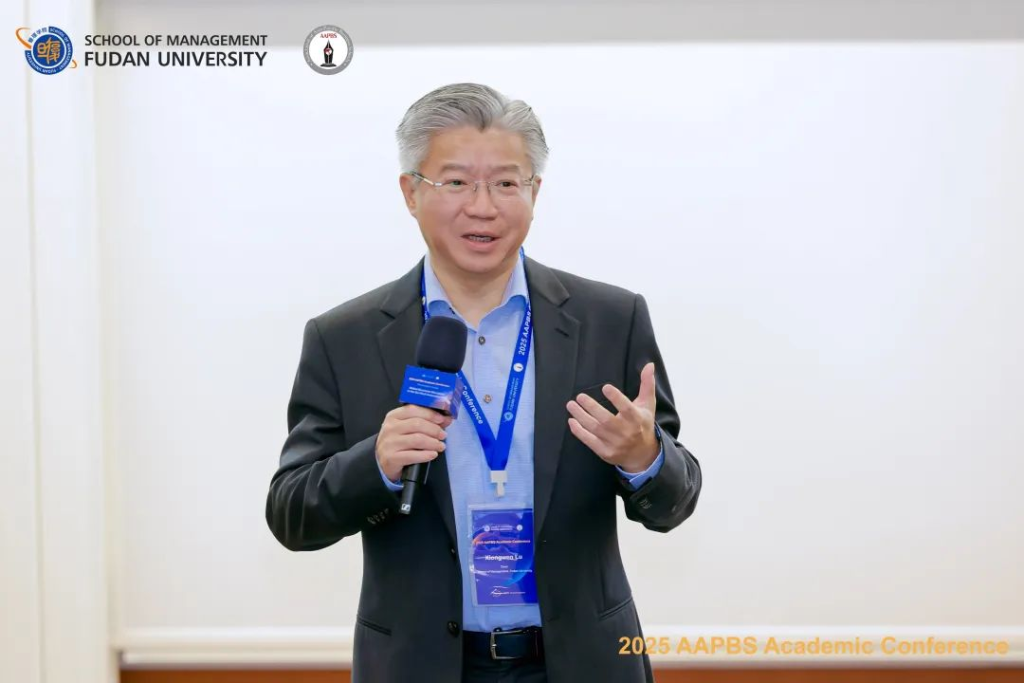
“We call for more dialogue, exchange, and collaboration,” said Professor Xiongwen Lu, Dean of Fudan SoM, in his welcome speech. Dean Lu noted that this year marks the 40th anniversary of the School’s re-establishment. The School has consistently adhered to its founding mission, aiming to rank among the world’s top business schools and lead the evolution of management education in the age of technological innovation. The conference brought together scholars and entrepreneurs from diverse backgrounds. Amid the current international landscape, it is expected that business schools in the Asia-Pacific region will strengthen dialogue and cooperation to elevate the region’s business education.
“As education practitioners, we can promote dialogue and reflect on the future of management education in various ways,” stated Professor Jikyeong Kang, President of the Asian Institute of Management and current AAPBS President, in her opening remarks. She highlighted AAPBS’s efforts to innovate and deliver unique benefits to its members. She also expressed gratitude to the Fudan AAPBS Team for hosting the conference and encouraged all attendees to forge new connections while rekindling existing ones through discussions and exchanges.

Focusing on the theme “Sci-Tech Innovation and Management”, Professor Jianping Ma, Dean of the Multiscale Research Institute for Complex Systems at Fudan University and Leading Scientist at the Shanghai Artificial Intelligence Laboratory, and Professor Xiaohong Jiang, Chair of the Department of Finance at School of Management at Fudan University, delivered keynote addresses separately.
Professor Ma analyzed the potential and limitations of AI in bio-medicine based on his research in AI and drug design. He emphasized that experimental research remains essential in bio-medicine. Although AI can generate large amounts of data, experimental verification is still required. Looking ahead to the next decade, he envisioned a future where digital and healthcare technologies could significantly extend human lifespans and improve quality of life, particularly for younger generations.

Professor Jiang shared her research on the relationship between financial markets and tech companies. She emphasized the critical role of interdisciplinary collaboration in frontier fields such as quantum computing and synthetic biology. While capital markets profoundly influence tech firms, mismatches in supply and demand pose financing challenges, especially during the transition from lab to market. She underscored business schools’ responsibility to drive economic development and the need for better communication between investors and entrepreneurs to advance technological frontiers.

The first panel was chaired by Professor Shengming Liu, Associate Professor at Fudan SoM. Panelists included Mr. Bing Wang, the Chairman of the Shanghai Humanoid Robot Innovation Incubator; Professor Zhejun Yu, Associate Professor at School of Philosophy, Fudan University; and Mr. Guanlei Zhao, Vice General Manager of Shanghai Maxim Technology Company. They discussed the application potential of AI technology and innovation challenges for tech companies as well as the enhancement of leadership skills.

Professor Dominique Turpin, the European President of CEIBS, delivered a keynote Speech on “Globalizing Asia-Pacific Business Education”. He discussed trends, opportunities, and challenges in business education, noting that geopolitical and economic uncertainties have led to more uncertain education choices for students. Changes in visa policies also affect study-abroad trends, with more students opting to study domestically. As employers prioritize problem-solving and AI-related skills, he urged business schools to further enhance their globalization level through initiatives such as dual-degree programs to meet market demand.
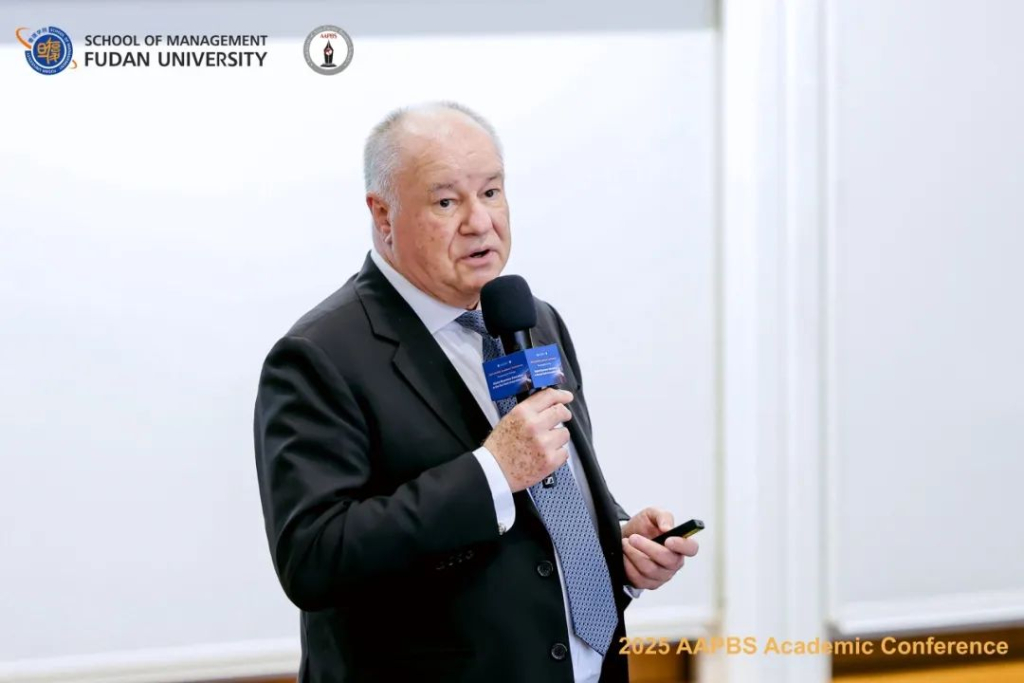
The second panel was chaired by Professor Dominique Turpin. Panelists included Professor Ian Fenwick, Director of Sasin School of Management in Bangkok, Thailand; Ms. Yulia Jiang, Head of School Relations, Greater China, at Graduate Management Admission Council; Mr. Jeongmin Seong, partner at the McKinsey Global Institute, McKinsey & Company’s business and economics research arm; Professor Jumana Zahalka, Deputy Dean of the NUS Business School. The discussion focused on the trend of business education under globalization and technological development, and how to integrate the resources of various universities to balance the needs of local and global markets as well as cultivate internationally competitive talents.

The third panel was chaired by Professor Brent Ritchie, Dean of the Business School at the University of Queensland. Panelists included Professor Violetta Grigorieva, Executive Director of Faculty & International Affairs, Moscow School of Management SKOLKOVO; Professor Bryan Jean, Associate Dean of International Affairs and Director of Global MBA at College of Management, National Taiwan University; Professor Patrick Poon, Associate Dean of Faculty of Business at Lingnan University. The panelists shared their practical experiences and discussed how management education can adapt to technological innovations, particularly the changes brought by AI.

Dean Lu delivered a Keynote speech on “How does Sci-Tech Innovation Drive the Development of Management Education”. He analyzed challenges faced by startups in their “from 0 to 1” journey, emphasizing the need for talent aligned with evolving missions. He highlighted that interdisciplinary research is crucial in today’s business education, not only within the business school but also involving diverse fields like engineering, computer science and biotechnology. Fudan SoM advocates the concept of “No Sci-Tech Innovation, No Future,” fully implementing a sci-tech innovation strategy to cultivate more entrepreneurs and young management talent for sci-tech enterprises. In the future, business schools must transform and upgrade, with management teams having the courage to change. Through theoretical, tool, and methodological innovations, they should restructure educational systems, further reform traditional MBA and EMBA programs, so as to continuously enhance students' understanding and application of technology to cultivate business leaders who can meet the future societal and economic demands.

As one of Asia’s leading and China’s top business schools, Fudan SoM has actively participated in AAPBS activities over the years. In the future, the school will continue to carry out extensive collaboration with other excellent business schools in the Asia-Pacific region, promoting educational innovation and resource sharing to jointly advance the prosperity of business education.
On May 20, the attendees visited The Shanghai Humanoid Innovation Incubator, gaining insights about the city’s latest developments in high-tech fields like AI and robot manufacturing. They investigated the construction of the incubator, studied its special incubation concept of “closed loop of technology, finance and support”, engaged in in-depth exchanges with outstanding enterprise representatives and interacted with intelligent robots on-site to experience the “human-machine collaboration”.
Association of Asia-Pacific Business Schools (AAPBS) was founded in 2003 by 11 business schools in the Asia-Pacific region. It is a regional, non-profit organization with over 100 member institutions and 21 council members. AAPBS is committed to promoting the development and cooperation of business schools in the Asia-Pacific region, enhancing their overall quality and international influence, and fostering innovation and development in teaching, research, and social responsibility. It also strengthens academic exchanges, resource sharing, and collaborative projects among member institutions.
