The 2024 Workshop on Innovative Research in Digital and Intelligent Operations Held at FDSM
August 15, 2024
On July 16, the 2024 Workshop on Innovative Research in Digital and Intelligent Operations was held at School of Management, Fudan University. Eight professors from home and abroad presented a series of fascinating academic presentations.
Fuqiang Zhang, the Co-Chair of organizing committee and Professor from Washington University in St. Louis, hosted the opening ceremony and delivered the opening remarks. He shared a warm welcome to all the scholars and guests attending the workshop.
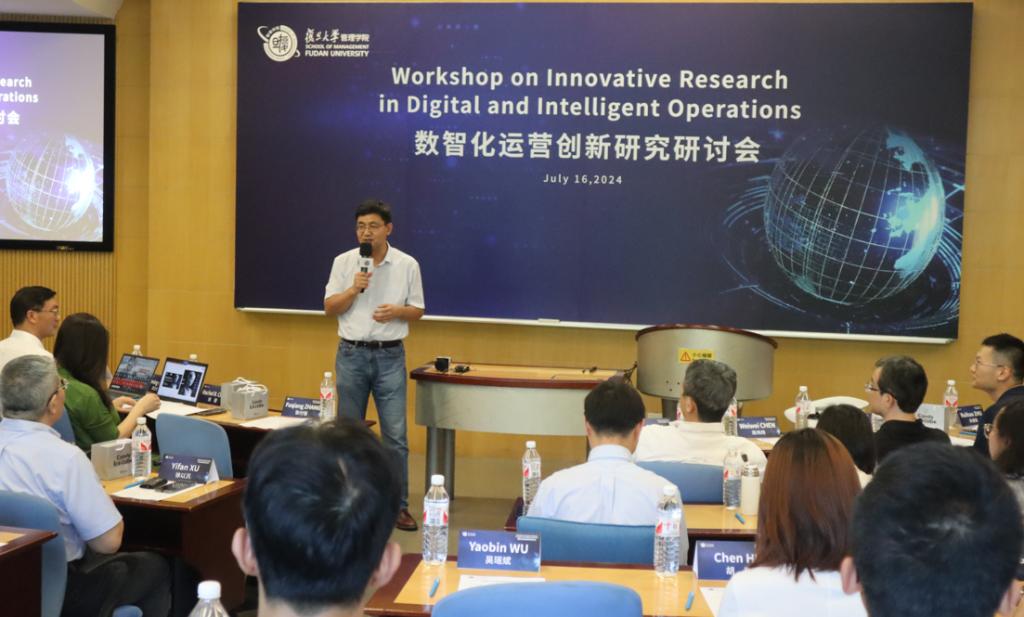
In the morning, Professor Tat Chan from Washington University in St. Louis conducted a keynote speech titled “The Intended and Unintended Consequences of Privacy Protection in Social Media: A Large-Scale Field Experiment and Structural Analysis.” With privacy protection increasingly gaining attention from consumers and governments, many companies offer privacy options for users to choose from. Professor Chan presented the results of his collaboration with a team from a major social media platform. At First, the team conducted a field experiment on the platform to study the users’ reactions to privacy protection options (“Do Not Recommend to Friends”). The research found that setting a privacy protection option made users more aware of privacy risks, which lead to reduced usage time, even though most users did not activate the option. Secondly, the team found that government intervention in privacy protection could significantly enhance both consumer welfare and platform profits through structural analysis, and achieve win-win. Moreover, the platform could achieve similar benefits by increasing awareness of the privacy protection options among users.
Professor Rachel Chen from University of California, Davis, shared a keynote speech titled “GenAI Assistance in a Professional Service Market: The Perish of Second Opinion.” Professor Chen explored the impact of Generative AI (GenAI) in vertically differentiated professional service markets, such as healthcare and financial consulting. In this market, a high-level professional service provider and two lower-level service providers offer services to consumers. The research found that after service provider adopt AI assistance, high-level professional service provider may increase profits, while profits of low-level professional service providers tend to significantly decrease. Moreover, low-level consumers always gain a surplus benefit when service providers use AI assistance, whereas high-level consumers may suffer a surplus loss. Finally, if neither of the two low-level professional service providers adopts AI assistance, or if only one adopts it, the market tends to reach a certain equilibrium state.
Professor Weiwei Chen from Rutgers University delivered a keynote speech titled “Optimizing Resource Allocation in Service Systems via Simulation: A Bayesian Formulation.” She addressed the issue of long wait times and low service rates in emergency rooms of healthcare systems, particularly the difficulty in ensuring service rates for non-emergency patients. Hospitals aim to improve the treatment rates for these patients. She discussed this problem as a nonlinear issue that requires simulation optimization, posing challenges to computational efficiency. Considering the practical usage scenarios in hospitals, Professor Chen proposed an algorithm called Optimal Computing Budget Allocation for Problems (OCBA-P), with the Expected Opportunity Cost (EOC) as the optimization objective. Compared to traditional methods, this new method shows significantly improved performance, especially under limited computational resources. Taking the aforementioned emergency room issue as an example, the new method can significantly increase the service rate for fourth-category patients by approximately 30%.
Professor Yeming Gong from Emlyon Business School presented a keynote speech titled “AI and Management Science: A Perspective of New Research Philosophy.” He discussed how AI is reshaping the research philosophy and methodology of management science. Professor Gong first introduced the new research philosophy related to AI in the social sciences, particularly exploring the emerging new research paradigms in AI and Economics. He then discussed the relationship between AI and Management Science from a philosophical perspective, covering various aspects such as ontology, epistemology, axiology, and methodology. Additionally, Professor Gong proposed a series of research methods based on philosophical stances and summarized a new Management Science approach grounded in AI.
In the afternoon, Professor Xi Li from HKU Business School conducted a keynote speech titled “When Historical Prices Become Transparent, Must Consumers be Better Off?” Traditionally, consumers were generally unaware of historical prices, but now they can easily access this information. For example, some shopping platforms such as HKTVMall directly display historical prices, while third-party platforms such as CamelCamelCamel provide historical price searches. Positive reviews may come from either high quality or low prices, and the transparency of historical prices will influence consumer evaluations. When historical prices are hidden, consumers cannot distinguish between these two factors, and sellers are motivated raise ratings by lowing prices. However, when historical prices are transparent, this strategy becomes ineffective. Through a numerical example, Professor Li found that sellers might increase prices when prices become transparent. Therefore, consumers may not benefit from the historical price information.
Professor Anyan Qi from the University of Texas at Dallas shared a keynote speech titled “Combating Excessive Overtime in Global Supply Chains.” The research provides a comparative analysis of the operational strategies manufacturers employ to address the issue of excessive overtime among their suppliers. The results indicate that when auditing is the only feasible strategy, it can effectively mitigate suppliers' violations only when the accuracy of the audit is significantly high. When both capacity subsidies and auditing are feasible, capacity subsidies may serve as a beneficial complement. Secondly, when capacity subsidies and auditing are considered as alternative strategies, capacity subsidies might have the opposite effect, leading to an increased expectation of excessive overtime and a reduction in social welfare. Finally, when cross-training and auditing are both feasible, cross-training can also complement auditing, which primarily driven by the enhanced flexibility of the workforce. However, similar to capacity subsidies, cross-training may also backfire, resulting in increased excessive overtime and a decrease in social welfare.
Assistant Professor Ruihao Zhu from Cornell University delivered a keynote speech titled “Temporal Fairness in Learning and Earning: Price Protection Guarantee and Phase Transitions.” The research highlighted that “price protection” can effectively ensure temporal fairness for customers in dynamic pricing. Under the price protection, customers who purchase a product can receive a refund from the seller equal to the difference between the promotional price and the original purchase price if the price drops within the protection period. Professor Zhu explored the impact of the price protection on online learning-based dynamic pricing algorithms and pointed out LEAP, a novel phased exploration algorithm for Learning and EArning under Price Protection, for data collection and statistical estimation under price protection. His research found that when the price protection period is short, the profits for sellers are not significantly different from situation without a price protection. Furthermore, even if the price protection period is extended, the profit losses for sellers has an upper limit. Finally, through numerical simulations on both synthetic and real datasets, Professor Zhu presented that LEAP has advantages over other heuristic methods.
Professor Huiqi Guan from Fudan University presented a keynote speech titled “Personalized Pricing with Storable Products.” With the advancement of information technology, companies have more tools to gather consumer information, enabling them to implement personalized pricing. This often involves offering more favorable prices to new customers. In traditional research, it is believed that fully personalized pricing (FPP) in markets for non-storable goods can achieve a win-win situation for all parties. However, for storable goods, forward-looking consumers may take advantage of new customer discounts by stocking up. Professor Guan's research found that the use of personalized pricing in markets leads to non-monotonic changes in corporate profits, which are lower than the profits for non-storable goods. It also reduce consumer surplus and social welfare. Therefore, when considering the storability of goods, companies need to be cautious in using personalized pricing and choose appropriate pricing strategies.
After the speeches from the eight professors, the workshop concluded with enthusiastic applause. Professor Zhang summarized the closing remarks, expressing sincere gratitude to the attendees and extending an invitation to experts and scholars for next year's Workshop on Innovative Research in Digital and Intelligent Operations.
Following the workshop, Tianjun Feng, the Co-Chair of the organizing committee and Professor from Fudan University, invited the attendees to visit the Zhengli New Campus of School of Management. Qingyun Peng from the School of Management welcomed the visiting guests. She introduced the layout and design philosophy of the Zhengli New Campus and led a tour of the main facilities of it.
