
Another Top-Tier International Journal Publication from Fudan SoM:
A New Mechanism Elevates Undervalued Women Leadership
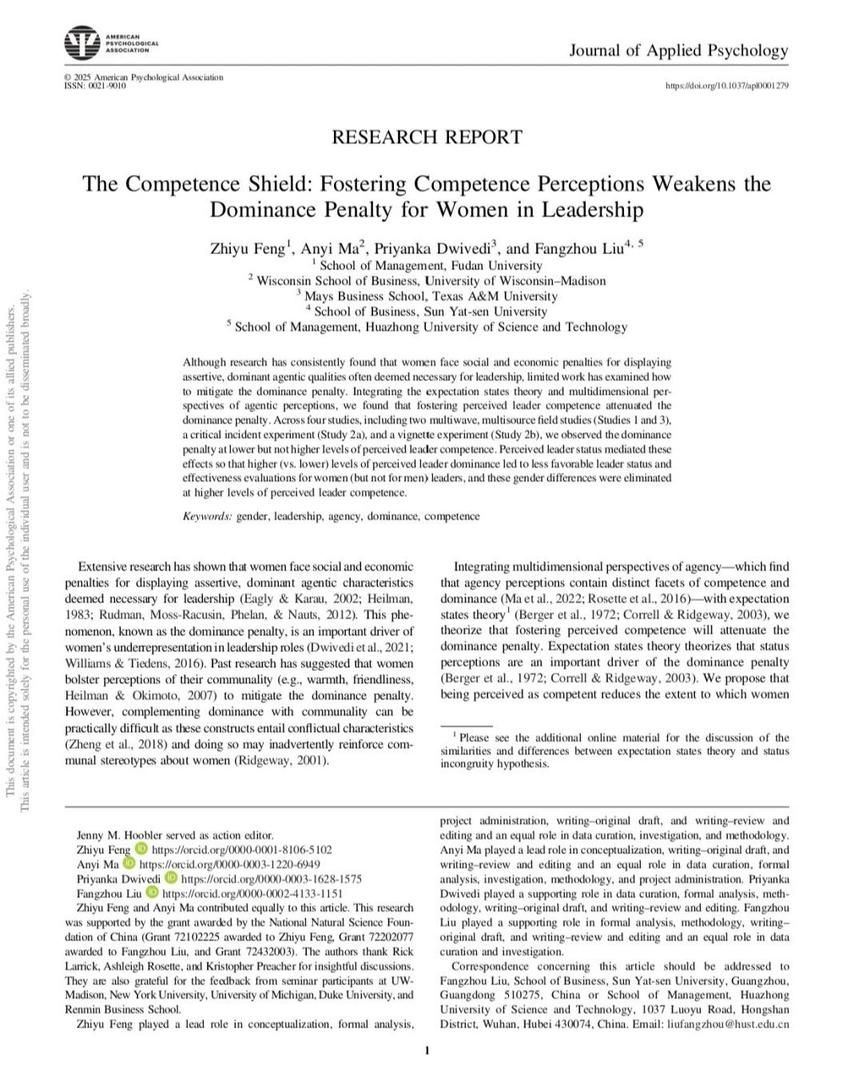
Recently, a paper co-authored by Associate Professor Zhiyu Feng of the Department of Management, School of Management at Fudan University (Fudan SoM) and his collaborators, titled The Competence Shield: Fostering Competence Perceptions Weakens the Dominance Penalty for Women in Leadership, was officially published in the Journal of Applied Psychology, a top-tier international journal in the fields of management and applied psychology.
Why is "competence" so critical when women display authority?
In long-standing traditional stereotypes, perceptions of men and women leaders have been highly asymmetrical. Men are more readily associated with dominance, decisiveness, and assertiveness, whereas women are often viewed as friendly, warm, and nurturing. When "leadership" is implicitly equated with authority, control, and decisiveness, it is naturally more easily aligned with stereotypically male traits, while female traits are seen as mismatched with the authority and dominance expected of leaders.
This asymmetry gives rise to a pervasive bias: when male leaders exhibit authority and dominance, such behavior is often regarded as "natural" or "to be expected"; when women leaders display the same behaviors, however, they are more likely to be perceived as "inappropriate," "unlikable," or even "unsuited for leadership." This paper centers precisely on understanding and breaking this bias.
The core theoretical contribution of the study lies in proposing a new mechanism—the "competence shield." We find that when women leaders are widely perceived as highly competent, their displays of authority and dominance are more readily understood and accepted. Competence confers legitimacy on authority, allowing it to be interpreted as the outcome of professional judgment and rational decision-making, rather than as an emotional or transgressive use of power.
This phenomenon is also evident in real-world contexts. Female political figures such as Margaret Thatcher or Hillary Clinton were able to have their decisiveness and toughness accepted by the public largely because their competence had already been broadly recognized. In contrast, when a woman leader leaves an impression of hesitation or lack of confidence in public settings, her authority—regardless of her formal position—is more likely to be questioned.
Across a series of empirical studies, we also identify a significant asymmetry: when leaders are perceived as having low levels of competence, women who display authority receive more severe negative evaluations than men. This difference stems in part from greater societal tolerance toward men, often rooted in the implicit assumption that men are "naturally" more suited to leadership. However, once women leaders are able to clearly demonstrate high competence, this evaluative gap narrows substantially, enabling them to exercise authority or lead decision-making without being easily labeled as "unprofessional" or "misplaced."
For this reason, we do not wish for these findings to be interpreted simply as suggesting that "women should work harder to prove themselves." In reality, women who reach leadership positions have often already faced higher barriers and more stringent selection processes than their male counterparts. Placing the burden back on individuals would itself be unfair. Accordingly, the study's practical implications are articulated across three distinct but interconnected levels.
First, for women leaders, the key is not to avoid authority, but to ensure that competence is visible. Many women tend to downplay their own contributions when achieving success or recognition, out of concern that they may be perceived as "showing off." From the perspective of our research, however, such competence signals are crucial. When one is perceived as highly capable, subsequent displays of authority and dominance are more likely to be interpreted as reasonable and legitimate leadership behavior.
Second, for supervisors and managers, how a woman leader is "introduced" and "presented" is equally important. Whether in public settings, evaluation systems, or processes of recommendation and endorsement, actively and explicitly emphasizing women leaders' professional expertise, performance outcomes, and concrete contributions effectively helps construct a "competence shield," protecting them from unnecessary doubt when exercising authority.
Third, for organizations, the most sustainable solution lies at the institutional level. Replacing vague, impression-based evaluations with more objective and quantifiable performance metrics—and reducing subjective judgments such as whether "she looks like a leader"—is essential to fundamentally mitigating the influence of gender stereotypes in leadership assessments.
The concept of the "competence shield" offers a mechanism that is actionable, empirically testable, and readily integrable into organizational practice. More importantly, this mechanism is not limited to gender contexts; similar "shield effects" may also exist in other settings of inequality, including race and identity-based disparities. We hope this research serves as a starting point, encouraging scholars and practitioners to explore diverse pathways through which authority and leadership can be disentangled from singular stereotypes and re-centered on competence itself—thereby advancing more diverse, equitable, and inclusive organizational environments.
